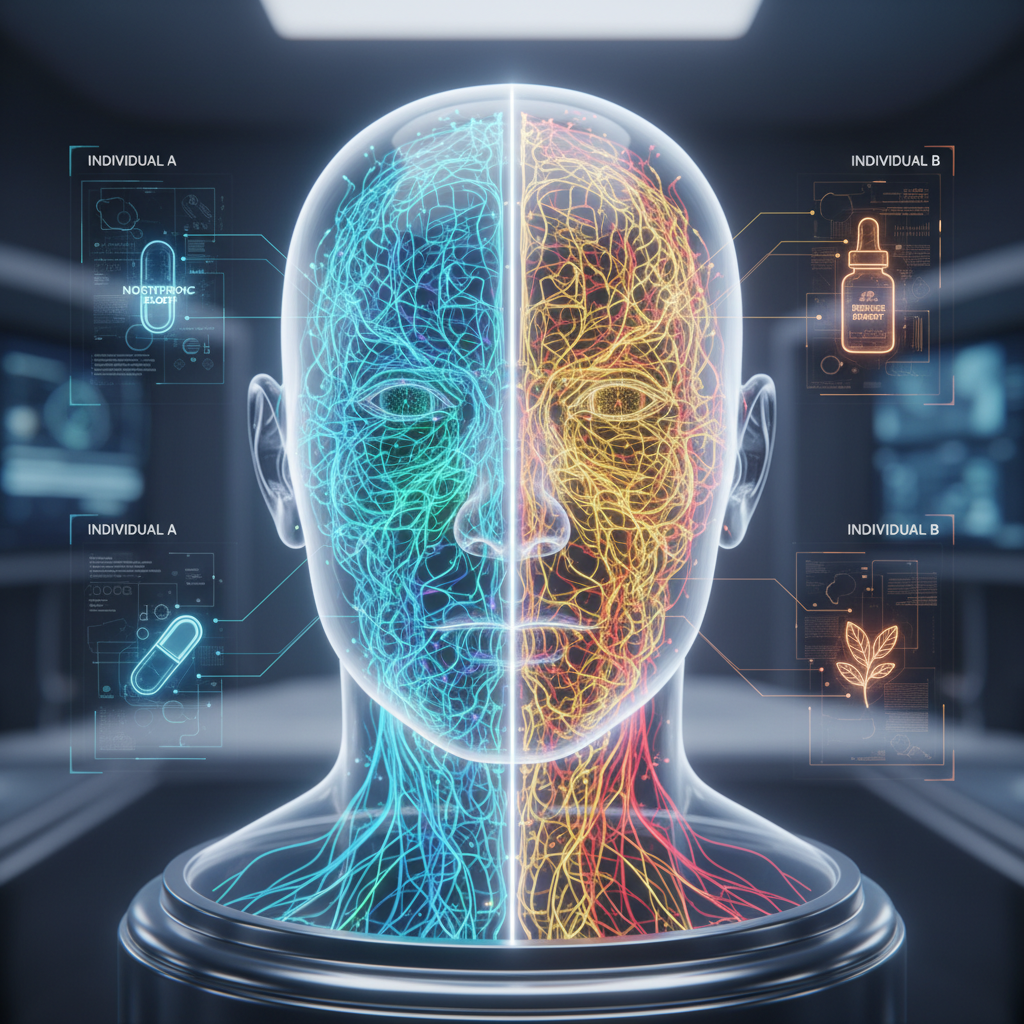
The Enigma of Individual Neurochemical Responses
For many exploring cognitive enhancement or mood support, the journey often involves a perplexing paradox: the same compound can elicit dramatically different effects across individuals. One person might find N-acetyl cysteine (NAC) a profound mood booster, while another experiences anhedonia. Methylfolate, a vital B vitamin, can be a game-changer for some and worsen symptoms for others. Even a common supplement like magnesium, celebrated for its calming properties, has been reported to induce depression in a subset of users. This variability is not merely anecdotal; it underscores a fundamental challenge in personalized health.
The current approach to understanding these individual differences is largely one of trial and error. Patients and clinicians alike navigate a complex landscape of supplements and compounds, hoping to stumble upon what works best. This process is not only time-consuming and costly but can also lead to frustration and a lack of trust in beneficial interventions. The question arises: why such disparate outcomes from identical substances?
Unraveling the Biological Blueprint of Variability
The answer lies deep within our unique biological blueprints. Our bodies are intricate systems, each subtly different from the next, influenced by a myriad of factors. Genetic predispositions play a significant role. Polymorphisms, or variations in genes, can alter how we metabolize, absorb, and respond to various compounds. For instance, variations in MTHFR genes can impact how an individual processes folate, directly influencing their response to methylfolate supplementation.
Beyond genetics, the gut microbiome emerges as a powerful modulator of neurochemical responses. The trillions of microorganisms residing in our digestive tracts produce a vast array of compounds, some of which are direct precursors to neurotransmitters or influence their availability. An individual’s unique microbial ecosystem can therefore dramatically alter how a neurochemical is processed or even its ultimate effect on brain chemistry.
Furthermore, individual metabolic pathways, nutrient status, lifestyle factors, and existing health conditions all contribute to this complex interplay. These factors create a unique neurochemical landscape within each person, dictating their specific reaction to exogenous compounds. Understanding these intricate interactions is the key to moving beyond generalized recommendations.
AI: The Navigator for Personalized Nootropic Prediction
This is where artificial intelligence (AI) offers a transformative solution. AI’s unparalleled ability to process and identify patterns within vast, complex datasets positions it as the ideal tool to decode individual neurochemical response variability. Imagine integrating an individual’s complete biological profile: their genomic data, detailed metabolomic assays, gut microbiome sequencing, lifestyle information, and even wearable-derived physiological data.
Integrating Diverse Data Streams
AI algorithms can ingest these multi-omic datasets, creating a holistic digital twin of an individual’s internal environment. By correlating these comprehensive profiles with observed responses to various neurochemicals, machine learning models can begin to identify subtle yet powerful predictive markers. This goes far beyond simple genetic tests, encompassing the dynamic interplay of all biological systems.
Predictive Modeling for Precision Interventions
The goal is to develop predictive models that can forecast, with high accuracy, how a specific individual will respond to a particular compound before they ever take it. Instead of guessing, clinicians could consult an AI-powered platform to receive personalized recommendations, suggesting compounds most likely to be beneficial and identifying those that might be ineffective or even detrimental.
Such a system would dramatically reduce the reliance on trial-and-error, saving patients time, money, and frustration. It would empower clinicians with data-driven insights, leading to more precise, effective, and safer personalized health strategies. This paradigm shift represents a move from generalized medicine to truly individualized neurochemical support.
The Future of Precision Neurochemistry
While the promise of AI in personalized neurochemical prediction is immense, its realization requires robust data collection, ethical considerations, and rigorous validation. Building comprehensive databases that link multi-omic profiles with observed outcomes will be crucial. Collaborative efforts between healthcare providers, researchers, and technology developers are essential to overcome these challenges.
The journey towards a future where neurochemical interventions are precisely tailored to each individual is well underway. AI is not just a tool; it is the catalyst for a new era of personalized health, where the mystery of individual variability is finally unraveled, leading to more effective and predictable outcomes for everyone.
Key Takeaways
- Individual responses to neurochemicals (e.g., NAC, methylfolate, magnesium) vary significantly due to unique biological factors.
- Genetic variations, gut microbiome composition, and metabolic pathways are key drivers of this variability.
- Current approaches rely heavily on inefficient trial-and-error methods.
- AI can integrate diverse data streams (genomics, metabolomics, microbiome, lifestyle) to create comprehensive individual profiles.
- Machine learning models can predict individual responses to compounds, offering personalized recommendations.
- This AI-driven approach promises to transform clinical practice, reducing guesswork and enhancing treatment efficacy and safety.